

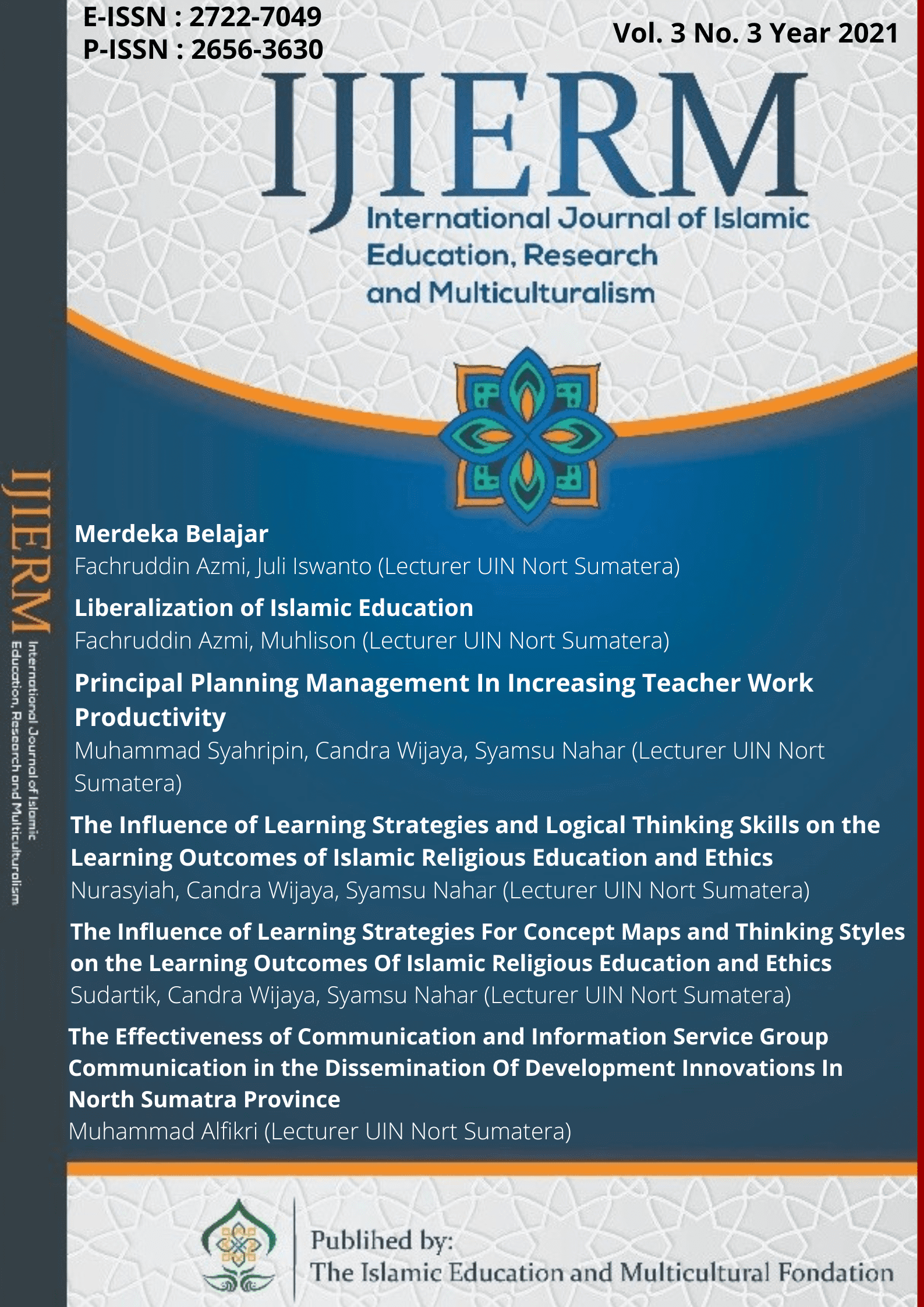
Volume 3, Number 3 (2021) of IJIERM presents six scholarly articles involving fourteen authorship entries, addressing educational freedom, Islamic educational thought, school leadership, learning strategies, and development communication. The contributions examine the conceptual foundations of Merdeka Belajar and the implications of intellectual freedom for contemporary Islamic education. Other studies investigate principals' planning strategies for improving teacher productivity and the relationship between instructional approaches, logical thinking abilities, and students' achievement in Islamic religious education and ethics. Further research explores the effectiveness of concept mapping, differences in students' thinking styles, and instructional strategies for improving educational outcomes. The issue also examines government communication practices in disseminating development innovations in North Sumatra. Collectively, these studies emphasize educational autonomy, evidence-based instructional innovation, professional leadership, and effective public communication in advancing educational quality and social development.
IJIERM Indexed By:











INTERNATIONAL JOURNAL OF ISLAMIC EDUCATION, RESEARCH, AND MULTICULTURALISM
The Islamic Education and Multicultural Foundation
Jl. Rambutan, Caru Hamlet, Pendem Village, District Junrejo, Postal Code 65321, Batu City, East Java, Indonesia.

This work is licensed under a Creative Commons Attribution-NonCommercial-ShareAlike 4.0 International License.